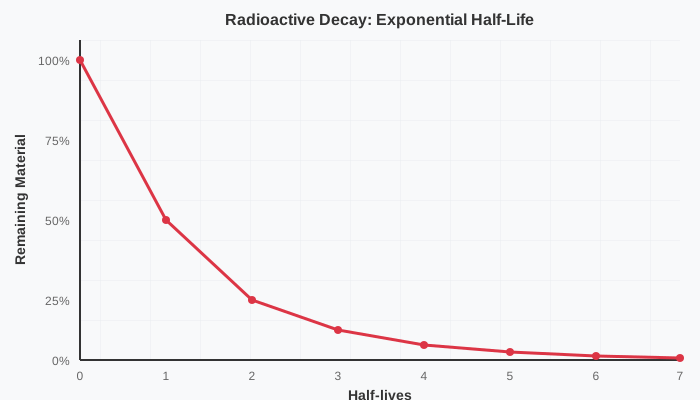
In nuclear physics, half-life describes the time it takes for half of a radioactive substance to decay. After one half-life, you’re left with 50% of the original material. After two half-lives, 25%. After three, 12.5%.
Knowledge in the tech industry follows a similar pattern of exponential decline, but with one crucial difference: unlike radioactive materials, the half-life of technical knowledge itself is getting shorter.
The Scale of Knowledge Decay Link to heading
The acceleration of knowledge obsolescence isn’t just a feeling - it’s measurable. Research shows that engineering knowledge, which once had a half-life of 35 years in 1930, dropped to about 10 years by 19601. More recent estimates from the National Academy of Engineering suggest it’s now somewhere between 2.5 and 7 years, depending on the specialty.
In software development, the pace is even more dramatic. Consider that JavaScript frameworks like Angular, React, and Vue have all emerged and evolved significantly just within the last decade. The containerisation technologies that define modern infrastructure - Docker, Kubernetes, serverless computing - barely existed 15 years ago but are now essential knowledge for most backend developers.
Meanwhile, entire categories of once-critical knowledge have become historical curiosities. How many developers today know how to configure Apache virtual hosts, optimise MySQL query caches, or deploy applications via FTP? These were core skills just a generation ago.
The pattern is clear: the more digital and interconnected our tools become, the faster they evolve, and the shorter the lifespan of specific technical knowledge.
What Actually Matters Now Link to heading
Consider the systems administrator who spent decades mastering a particular Unix variant. They knew every configuration file, every performance tweak, every weird edge case. Today, that same role involves managing containerised applications across multiple cloud providers, with infrastructure that’s constantly changing.
The specific knowledge becomes obsolete, but here’s the thing: the underlying skills are still valuable. Understanding how systems work, being able to debug complex problems, thinking about performance. That stuff translates.
We’re not losing technical knowledge. We’re just learning different kinds of it.
Digital Knowledge and the Lindy Effect Link to heading
The Lindy effect tells us that older knowledge is more likely to persist. We’re unlikely to lose the knowledge of how to use fire to cook food. Algorithms and data structures from the 1960s still form the foundation of computer science. But most of the web that has ever existed has already disappeared2 and the APIs and tools you learned last year have been deprecated.
This creates a useful hierarchy in tech knowledge:
- Fundamental principles: Decades to centuries (algorithms, system design)
- Implementation patterns: Years to decades (how to structure code, architectural approaches)
- Specific technologies: Months to years (most JavaScript frameworks, whatever other flashy tool)
- Configuration details: Weeks to months (API endpoints, deployment scripts)
The trick is knowing which layer you’re working in and not getting too attached to the bottom two.
Why This Keeps Happening Link to heading
This acceleration is driven by how the tech industry works. Companies that can ship faster and grab more attention will beat those focused on making things that last. But this isn’t entirely bad:
- If you can pick up new tech quickly, you’re valuable
- Seeing patterns across different systems is increasingly rare
- Companies get fresh approaches to old problems
- The whole industry moves faster
Instead of making experience worthless, this rewards people who can adapt and spot patterns. The skills that stick around even when the tech doesn’t.
What Actually Works Link to heading
When specific technical knowledge expires quickly, other things become more important. The developers who do well in this environment have figured out how to learn:
- Spotting the core ideas behind new technologies
- Moving knowledge between different areas
- Telling the difference between fundamental concepts and implementation details
- Building networks that help them stay current
This isn’t about age, it’s about approach. A 50-year-old developer who’s learned how to learn can adapt faster than a 25-year-old who’s only ever worked with one stack and is reluctant to touch anything else.
What We’ve Lost and What We’ve Gained Link to heading
The programmer who knew every edge case and quirk in a legacy COBOL system had irreplaceable knowledge. But what we’ve gained is a generation of developers who can quickly understand the principles underlying any system, adapt to new paradigms rapidly, and transfer problem-solving skills across different technologies.
We’ve traded depth in specific systems for breadth across many systems, and the ability to quickly develop new depth when needed. In a world where the average web application uses dozens of different technologies, this breadth is often more valuable than deep specialisation in any single tool.
How to Deal With It Link to heading
The forces driving knowledge decay aren’t going away, but they’re also what makes the industry interesting. Here’s what actually works:
Learn the stuff that lasts: Spend time on concepts that stick around. Understanding how distributed systems work will help you longer than becoming an expert in whatever message queue is trendy this month.
Get good at learning: Figure out how to quickly evaluate new tech. Being able to prototype something and decide if it’s worth your time is more useful than being the world’s expert in any single tool.
Focus on transferable skills: Communication, system design, debugging. This stuff works everywhere. These skills get better over time even when your specific tech knowledge expires.
Stay plugged in: The tech community tells you what’s coming next. Follow the right people, go to conferences and keep networks that help you spot trends before they become job requirements.
Conclusion Link to heading
Technical knowledge expires faster than ever, and that’s not changing. But this isn’t the end of the world. It’s just how the industry works now.
The developers who do well aren’t the ones fighting this reality, but the ones who’ve figured out how to work with it. They’ve got systems for learning new things, they’ve built careers on skills that transfer between technologies, and they’ve turned constant change from something scary into something useful.
Your current tech stack will be obsolete soon. So will the next one. But being able to pick up new technologies quickly, spot patterns across different systems, and solve problems in creative ways? Those abilities get more valuable every year.
Charette, Robert N. “An Engineering Career: Only a Young Person’s Game?” IEEE Spectrum. The concept of “half-life of knowledge” was originally coined by economist Fritz Machlup in his 1962 work “The Production and Distribution of Knowledge in the United States.” ↩︎
Research from the Pew Research Center showed that in 2024 38% of webpages from 2013 were already no longer available ↩︎